
"each tree"
10000 article(s) found

Common sense of Coffee Tree introduces the basic knowledge of coffee
The origin of the coffee tree is Ethiopia in Africa. In botany, coffee trees belong to the evergreen trees of the subgenus Rubiaceae, and coffee beans, commonly known as coffee beans, are actually the seeds of the fruit of coffee trees. They are called coffee beans only because they are shaped like beans. Climate is the decisive factor for coffee cultivation. Coffee trees are only suitable for growing in the tropics or subtropics, so latitude 25 degrees south and north.

Basic knowledge of Coffee planting requirements and conditions of Coffee trees
The origin of the coffee tree is Ethiopia in Africa. In botany, coffee trees belong to the evergreen trees of the subgenus Rubiaceae, and coffee beans, commonly known as coffee beans, are actually the seeds of the fruit of coffee trees. They are called coffee beans only because they are shaped like beans. Climate is the decisive factor for coffee cultivation. Coffee trees are only suitable for growing in the tropics or subtropics, so latitude 25 degrees south and north.

The knowledge of round beans, also known as male beans (Peaberry) in coffee beans is good or bad
Peaberry or caracoli is a variety of coffee beans. In fact, male beans are a defect, officially speaking, coffee beans that cannot develop normally. The causes are usually insect damage, drought, or malnutrition of coffee trees. Under normal circumstances, the fruit of the coffee tree contains two coffee beans, each of which is flat and hemispherical.

Columbia Hope Manor Coffee Grinding characteristics Variety Flavor description Taste introduction
The main varieties of Colombian coffee are small grains of coffee. Plants are small trees or large shrubs, 5-8 m tall, usually much branched at base; old branches gray-white, nodes dilated, young branches glabrous, compressed. Leaves thinly leathery, ovate-lanceolate or lanceolate, 6-14 cm long and 3.5-5 cm wide, tip long acuminate, acuminate part 10-15 mm long, base cuneate or slightly obtuse, rarely rounded, entire or
How much do you know about coffee?
Coffee (Xoffea arabica Linn) is a perennial evergreen shrub or small tree of Rubiaceae. It is a kind of horticultural perennial economic crop with the characteristics of fast growth, high yield, high value and wide market. Wild coffee trees can grow to 5 to 10 meters tall, but coffee trees grown on plantations are cut to less than 2 meters in order to increase fruit yield and facilitate harvesting. coffee

Selection of Autumn Coffee Story Arabica theme introduction hand-made coffee introduction
If the variety of coffee is divided by biology, it can be divided into Arabica, Robusta and Liberica. There are more than 6000 species of coffee trees, most of which are tropical trees and shrubs. There are four main kinds of coffee trees in the world, and only two of them are of real commercial value and have been planted in large quantities.

Colombia Hacienda Mallorca Estate Features Flavor Taste Treatments Variety
Professional coffee knowledge exchange More coffee bean information Please pay attention to Coffee Workshop (Weixin Official Accounts cafe_style) Hacienda Mallorca Estate is operated and managed by Santiago Londoo. This estate is owned by his father and his uncle. Coffee has been grown since 1932. This estate is in Valle del Cauca.

Description of Flavor and Flavor of Coffee Tree Flavor cycle introduction of Grinding scale for Variety characteristics of Manor treatment
Description of the Flavor of Coffee Tree flowering and fruiting cycle Flavor description of manor treatment Variety characteristics Grinding scale introduces that there are more than 100 original coffee producing areas in the world, and the coffee beans produced have their own characteristics. The purpose of mixing coffee beans is to balance the flavor of coffee and create an unparalleled delicacy. A single coffee bean generally lacks the complex flavor necessary to make delicious coffee. A lot of mixed coffee contains

The taste of Colombian coffee introduces the characteristics of Colombian boutique.
The main varieties of Colombian coffee are small grains of coffee. Plants are small trees or large shrubs, 5-8 m tall, usually much branched at base; old branches gray-white, nodes dilated, young branches glabrous, compressed. Leaves thinly leathery, ovate-lanceolate or lanceolate, 6-14 cm long and 3.5-5 cm wide, tip long acuminate, acuminate part 10-15 mm long, base cuneate or slightly obtuse, rarely rounded, entire or

Columbia Coffee Manor with Sweet Flavor characteristics of Fine Coffee beans
The main varieties of Colombian coffee are small grains of coffee. Plants are small trees or large shrubs, 5-8 m tall, usually much branched at base; old branches gray-white, nodes dilated, young branches glabrous, compressed. Leaves thinly leathery, ovate-lanceolate or lanceolate, 6-14 cm long and 3.5-5 cm wide, tip long acuminate, acuminate part 10-15 mm long, base cuneate or slightly obtuse, rarely rounded, entire or

Description of Flavor of High-quality Coffee beans in Colombian Coffee Variety producing area
The main varieties of Colombian coffee are small grains of coffee. Plants are small trees or large shrubs, 5-8 m tall, usually much branched at base; old branches gray-white, nodes dilated, young branches glabrous, compressed. Leaves thinly leathery, ovate-lanceolate or lanceolate, 6-14 cm long and 3.5-5 cm wide, tip long acuminate, acuminate part 10-15 mm long, base cuneate or slightly obtuse, rarely rounded, entire or

The ideal growing environment for coffee trees the common sense of coffee tree planting coffee tree varieties and regional factors
Professional coffee knowledge exchange more coffee bean information Please pay attention to coffee workshop (Wechat official account cafe_style) Coffee trees grow in the tropics between Tropic of Cancer and Tropic of Cancer and near the equator, also known as the world coffee growth belt, caffeine varieties and regional factors, there are also great differences in appearance. Evergreen leaves from yellowish green to dark green or

How about Honduran coffee? How to brew Honduran coffee with orange flavor
Professional coffee knowledge exchange more coffee bean information please follow the coffee workshop (Wechat official account cafe_style) Honduran coffee situation News! According to the Honduran Coffee Institute (IHCAFE), Honduras exported 281470 bags of coffee (60 kg each) in December 2020, down 20 per cent from 339952 bags in the same period last year. Honduran Coffee Institute

Flavor description of Arabica coffee beans in Latin America introduction to the regional treatment of manor production
Flavor description of Arabica coffee beans in Latin America the planting of coffee trees is only the first step in coffee production. When the coffee fruits are ripe, they can be harvested through picking equipment. Two seeds (Arabica coffee beans) are then extracted from each berry. The last step is to roast coffee beans for consumption. This removes moisture and changes coffee.

Colombia Na Linglong Coffee Grind Scale Variety Taste Manor Treatment Features Introduction
Colombia coffee has a silky texture. People equate Colombia coffee with high quality, good taste. It is sour with sweet, low bitter, rich in nutrients, with a unique sour and alcohol taste, Colombia premium coffee acid, bitter, sweet taste of the three just right. Unique fragrance, after drinking, the fragrance fills the whole mouth. The aroma in the mouth

Basic knowledge of coffee planting techniques and matters needing attention of coffee trees
The origin of the coffee tree is Ethiopia in Africa. In botany, coffee trees belong to the evergreen trees of the subgenus Rubiaceae, and coffee beans, commonly known as coffee beans, are actually the seeds of the fruit of coffee trees. They are called coffee beans only because they are shaped like beans. Climate is the decisive factor for coffee cultivation. Coffee trees are only suitable for growing in the tropics or subtropics, so latitude 25 degrees south and north.

What natural conditions do coffee trees need to grow?
The planting conditions of coffee trees the origin of coffee trees is in Ethiopia, Africa. In botany, coffee trees belong to the evergreen trees of the subgenus Rubiaceae, and coffee beans, commonly known as coffee beans, are the seeds of the fruit of coffee trees, just because they are shaped like beans, so they are called coffee beans. Climate is the decisive factor for coffee cultivation, and coffee trees are only suitable for growing in the tropics or subtropics.

What weather conditions are required for planting coffee trees
The planting conditions of coffee trees the origin of coffee trees is in Ethiopia, Africa. In botany, coffee trees belong to the evergreen trees of the subgenus Rubiaceae, and coffee beans, commonly known as coffee beans, are the seeds of the fruit of coffee trees, just because they are shaped like beans, so they are called coffee beans. Climate is the decisive factor for coffee cultivation, and coffee trees are only suitable for growing in the tropics or subtropics.

Bean / common bean, called Peaberry or caracoli in English, is a variety of coffee beans.
Round bean / common bean, known as Peaberry or caracoli in English, is a variety of coffee beans. In fact, the male bean is a flaw, officially speaking, it is not a normal development of coffee beans. The causes are usually caused by insect damage, lack of rain in case of prolonged drought, or malnutrition of coffee trees. In general, the fruit of a coffee tree contains two coffee beans, each in a flat hemispherical shape.

Coffee beans Coffee picking
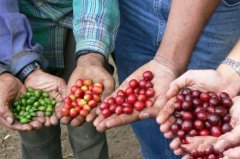
Coffee trees generally bloom in 3 to 4 years, about 2 to 3 months each year, similar in appearance and smell to jasmine flowers, closely clustered on branches when flowering, flowering 3 to 5 days. After flowering, they bear small green fruit, a few months later mature into red can be picked ripe fruit. Ripe fruit skin red, due to shape and color similar to cherry, many places called ripe coffee fruit coffee cherry